On January 16, 2024, PT PLN (Persero) announced plans to soon begin operating Indonesia’s first Hydrogen Refueling Station (HRS), located in Senayan, Jakarta. The facility is being developed by PLN’s subholding, PLN Indonesia Power, and is targeted for completion in February 2024.
Earlier, on November 20, 2023, PLN inaugurated 21 Green Hydrogen Plant (GHP) units across various regions in Indonesia. These plants produce hydrogen using electricity generated from solar power plants (PLTS) located within existing power plant areas. The total hydrogen production capacity from these facilities can reach 199 tons per year.
Out of the total annual production of 199 tons of hydrogen, approximately 75 tons are used for power generator cooling systems. The remaining 124 tons will be utilized for various purposes, including supplying hydrogen to the HRS that is scheduled to begin operations.
With the inauguration of these 21 GHP units, PLN now owns the largest number of green hydrogen plants operated by a single company or country in Southeast Asia. This advantage allows PLN to deepen its expertise and improve production efficiency, enabling it to become more competitive compared to neighboring countries.
Following the development of GHPs and HRSs, PLN plans to operate fuel-cell-based power plants that use green hydrogen as fuel. In addition, PLN will establish a Hydrogen Center and a Hydrogen Gallery Room for training and education related to hydrogen development in Indonesia.
Pertamina Also Begins Green Hydrogen Production
Beyond PLN, PT Pertamina (Persero), through its subsidiary Pertamina Geothermal Energy Tbk (PGEO), has also initiated green hydrogen pilot projects as of September 9, 2023. These projects are being carried out in Ulubelu and Lahendong, Indonesia.
In Ulubelu, green hydrogen is produced directly from geothermal energy and is planned for use in oil refinery operations. Meanwhile, the project in Lahendong remains at the study phase, conducted in collaboration with a Japanese company.
Indonesia’s Minister of State-Owned Enterprises, Erick Thohir, stated that Pertamina’s green hydrogen production will initially be focused on exports, with the possibility of domestic utilization in the future. Pertamina has also partnered with strategic partners from the Netherlands to develop wind power as part of its green hydrogen production strategy.
Challenges of Green Hydrogen: Cost Issues
Green hydrogen is produced using renewable energy sources such as solar and wind power. However, the main challenges remain high production costs and limited availability of renewable energy resources.
For comparison, grey hydrogen—produced from natural gas (a non-renewable source)—has a production cost of approximately €1–2 per kilogram. In contrast, green hydrogen production costs can reach €3–8 per kilogram.
Global and Domestic Demand
Global demand for green hydrogen is projected to grow moderately until 2030. After that, growth is expected to accelerate significantly, particularly after 2035, according to PwC research.
Domestically, based on IESR 2022 estimates, Indonesia is expected to require approximately 4 million tons of blue and green hydrogen by 2025. This demand is projected to double by 2030 and reach 17 million tons by 2040.
As technology advances and production scales increase, green hydrogen production costs are expected to decline over time.
Indonesia’s Potential as a Global Green Hydrogen Supplier
Yudo Dwinanda Priaadi, Director General of New, Renewable Energy, and Energy Conservation of Indonesia, stated that Indonesia has significant potential to become a global supplier of green hydrogen.
According to Hydrogen Business Desk, Indonesia’s large-scale renewable energy potential was estimated at 442 GW in 2018. This figure is substantial enough to position Indonesia as a major player in the global green hydrogen industry.
Becoming a Global Player: Cost as the Key Factor
To become a global supplier of green hydrogen, production cost will be a critical factor, as importing countries will naturally seek competitive pricing.
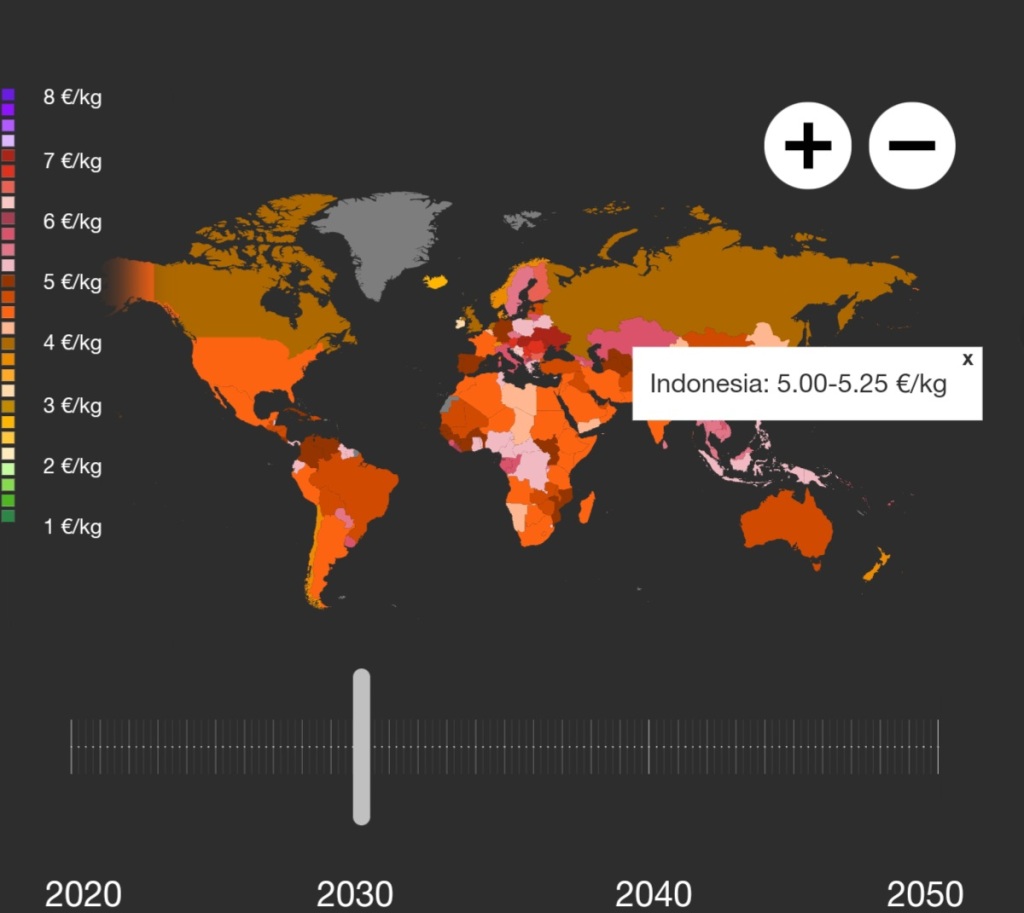
Based on PwC research, green hydrogen production costs in Indonesia are projected to range between €5.0–5.25 per kilogram by 2030. While this remains competitive within ASEAN, it is still higher than costs in China and India. Government policies and long-term energy development strategies will play a crucial role in reducing these costs.
Government Prepares Specific Hydrogen Regulations
Regarding government policy, Andriah Feby Misna, Director of New and Renewable Energy at Indonesia’s Ministry of Energy and Mineral Resources (ESDM), revealed that hydrogen regulations have already been incorporated into the New and Renewable Energy Law. The government is currently preparing specific regulations governing hydrogen as a fuel business in Indonesia.